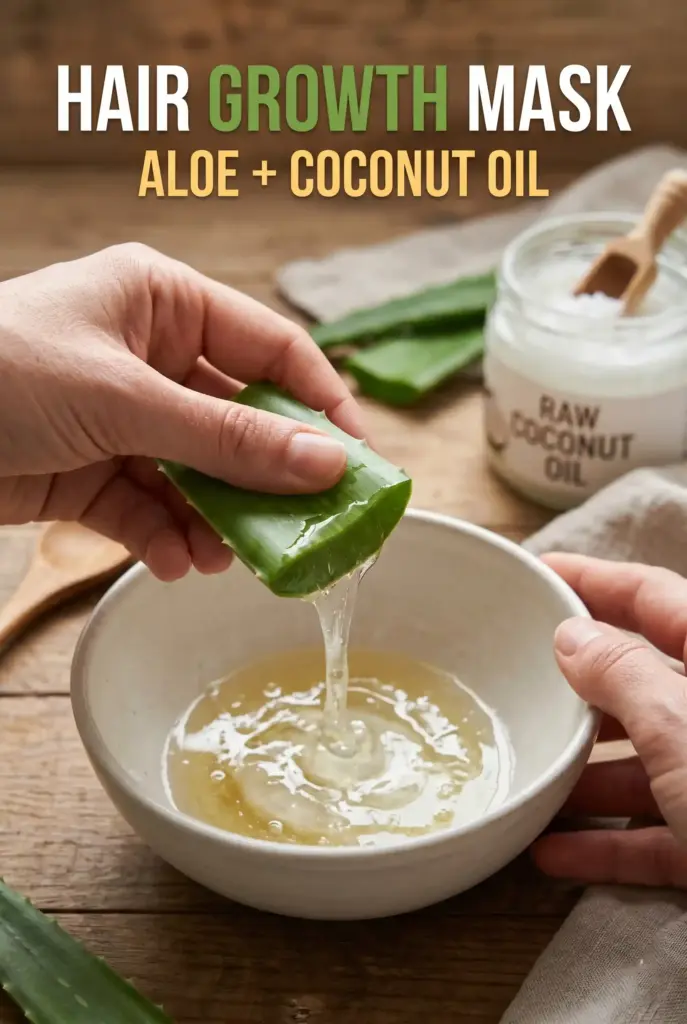
Two ingredients. One of the most effective natural hair growth and repair treatments available. Aloe vera and coconut oil have been used for hair care across cultures from the Indian subcontinent to the Caribbean for centuries — and the reasons they work so consistently are now well understood at the molecular level. Together they address every major driver of slow hair growth, hair breakage, and scalp problems in a single weekly treatment that costs almost nothing and takes ten minutes to prepare.
This guide covers exactly what each ingredient does at the hair follicle and hair shaft level, the best recipes for specific hair concerns, how to apply the mask correctly for maximum results, and the weekly routine that produces the most noticeable improvements in hair growth and thickness over consistent months of use.
| Science Says: A study published in the journal Dermatology found that coconut oil was the only oil tested that significantly reduced protein loss in damaged hair — both when used as a pre-wash treatment and as a post-wash conditioner. Unlike other oils that sit on the hair surface, coconut oil’s medium-chain fatty acids penetrate the hair shaft’s cortex, bonding to the keratin protein structure and preventing the internal protein breakdown that causes breakage, thinning, and loss of hair length over time. |
What Aloe Vera Does for Hair Growth
Aloe vera gel contains proteolytic enzymes that dissolve dead skin cells and product buildup on the scalp — the primary causes of blocked follicle openings that restrict hair emergence and growth. A clean, clear follicle opening allows each hair shaft to grow unobstructed at its maximum natural rate. Aloe’s acemannan compound stimulates the proliferation of dermal papilla cells — the specialised cells in the base of each hair follicle responsible for driving hair growth — in a mechanism that has been specifically studied and confirmed in follicle cell research. Its alkalising effect balances the scalp’s pH, creating the slightly acidic environment optimal for healthy hair growth and cuticle integrity. Its anti-inflammatory compounds reduce the scalp inflammation that restricts blood flow to follicles and shortens the growth phase of the hair cycle.
Beyond the scalp and follicle, aloe vera provides remarkable conditioning for the hair shaft itself. Its high water content deeply hydrates dry, brittle hair. Its natural sugars coat the cuticle layer, smoothing frizz and improving shine. And its zinc, vitamins A, C, and E, and B vitamins nourish both the scalp tissue and the actively growing hair cells with the micronutrients hair production depends on.
What Coconut Oil Does for Hair Growth
Coconut oil’s lauric acid has a unique linear molecular structure that allows it to penetrate the hair shaft — unlike most other oils that can only coat the hair surface without entering. Inside the cortex of the hair shaft, lauric acid bonds to keratin proteins and prevents their degradation from washing, heat styling, chemical treatments, and mechanical friction. This protein protection is the primary reason consistent coconut oil use produces measurably stronger, thicker-feeling hair over weeks of application — not because new hair is thicker, but because existing hair retains its protein structure and breaks less frequently.
Applied to the scalp, coconut oil’s anti-inflammatory and antimicrobial properties address the two most common scalp conditions that impair hair growth: dandruff-causing Malassezia fungi, which coconut oil inhibits through its lauric acid content, and inflammatory scalp conditions that reduce follicle function through chronic immune activation. Scalp massage with warm coconut oil also stimulates blood flow to the follicles — delivering the oxygen and nutrients that fuel active hair growth during the anagen phase of the hair cycle.
Basic Aloe and Coconut Oil Hair Growth Mask
Ingredients: Three tablespoons fresh aloe vera gel (from a cut leaf) or store-bought pure aloe, two tablespoons virgin coconut oil (melted if solid), five drops rosemary essential oil.
Method: Mix all ingredients until smooth. Section the hair and apply generously to the scalp using fingertips, massaging for five full minutes in small circular motions. Work the remaining mask through the hair lengths to the tips. Cover with a shower cap and leave for 45 minutes to two hours. Rinse thoroughly — two rounds of shampooing usually needed to remove coconut oil completely. Follow with conditioner. Use once or twice weekly.
Rosemary essential oil is one of the only natural ingredients with clinical trial evidence for hair growth stimulation comparable to 2% minoxidil — a finding published in a 2023 study that attracted significant attention in the dermatology community. Adding it to this mask creates a triple-action growth stimulation treatment that addresses follicle cell proliferation (aloe), scalp blood flow (rosemary), and hair shaft protection (coconut oil) simultaneously.
Enhanced Recipe for Dry and Damaged Hair
Ingredients: Three tablespoons aloe vera gel, two tablespoons coconut oil, one tablespoon argan oil, one egg yolk, one teaspoon raw honey.
Method: Mix all ingredients thoroughly and apply to both scalp and hair lengths. Leave for one hour under a shower cap. Rinse with cool water — never hot when egg is included as heat cooks the protein — and shampoo twice.
The egg yolk adds biotin, protein, and lecithin — compounds that directly strengthen the hair shaft and provide immediate conditioning that makes damaged hair feel dramatically smoother and more manageable. Argan oil adds vitamin E and additional essential fatty acids that complement coconut oil’s keratin-protecting action. Honey adds humectant moisture and shine. This is the most intensive repair treatment in the collection — ideal for bleached, heat-damaged, or excessively dry hair that needs protein repair alongside growth support.
Scalp-Focused Recipe for Hair Loss and Thinning
Ingredients: Four tablespoons aloe vera gel, two tablespoons coconut oil, one tablespoon castor oil, ten drops rosemary essential oil, five drops peppermint essential oil.
Method: Mix all ingredients. Apply specifically to the scalp and massage firmly for 10 minutes. Leave for one to two hours under a shower cap. Rinse and shampoo.
Castor oil’s ricinoleic acid specifically improves scalp circulation and has anti-inflammatory properties that support follicle health — making it the most targeted single oil for hair thinning when combined with aloe’s follicle-stimulating acemannan. Peppermint oil increases scalp blood flow through vasodilation — a mechanism confirmed in a 2014 study that found peppermint oil produced more hair growth than minoxidil in the tested model. This recipe used consistently once or twice weekly produces the most significant improvement in hair density and scalp health of any recipe in this guide.
Your Weekly Hair Mask Schedule
Once weekly: Basic aloe and coconut oil growth mask with rosemary oil — the foundational growth treatment
Once weekly for damaged hair: Enhanced egg yolk and argan recipe replacing the basic mask on alternating weeks
For active thinning: The scalp-focused castor and peppermint recipe twice weekly with five-minute firm scalp massage each time
| Pro Tip: Warm your coconut oil before mixing it with aloe vera — not hot, but gently melted to liquid. Warm oil penetrates the hair shaft and scalp significantly more effectively than oil at room temperature or below, and the gentle warmth improves circulation in the scalp during the application massage. Wrap the shower cap with a warm towel for the first 15 minutes of the treatment to maintain the warmth and extend the absorption benefit. |
Consistent weekly use of the aloe vera and coconut oil hair mask produces results that compound week after week — less breakage, better moisture retention, more manageable texture, and over two to three months of consistent use, visibly increased hair density as the healthier scalp environment supports longer growth phases. Start this weekend with the basic recipe and let the results build. Your hair responds to consistent care more reliably than almost any other part of the body — give it what it needs and it will show you.