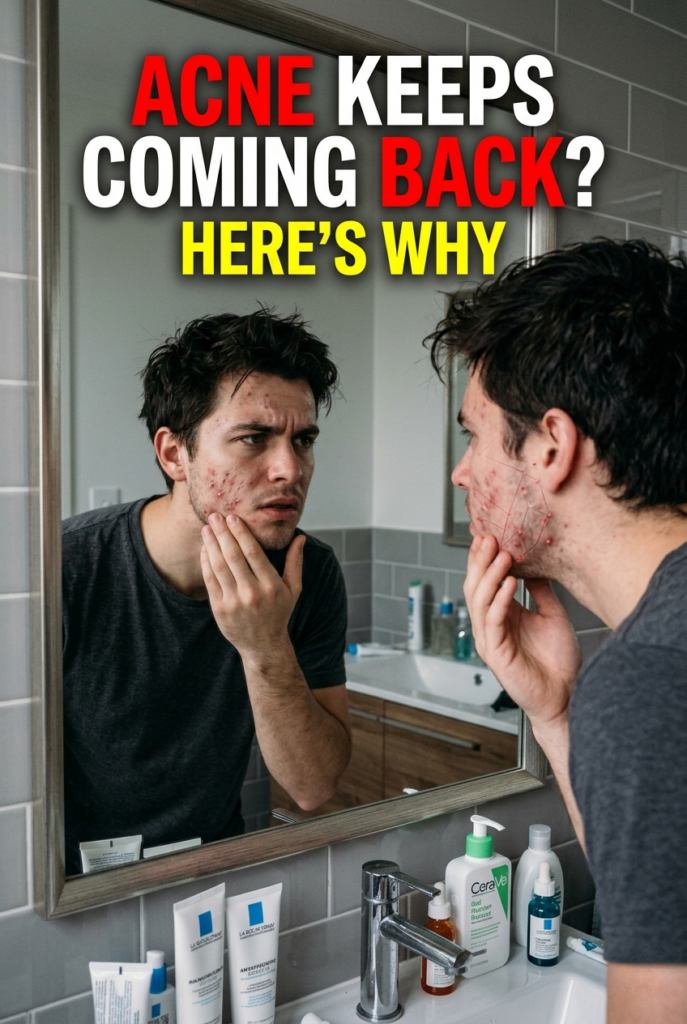
You have tried the cleansers, the toners, the spot treatments, and the serums. You wash your face morning and night. You change your pillowcase regularly. You have cut out dairy, reduced sugar, and drink more water. And still — just when your skin finally starts to clear, the breakouts return. Sometimes in exactly the same spots. Sometimes worse than before. It feels like your skin is working against you, and the frustration of doing everything right and still not getting clear skin is something millions of people experience daily.
The reason acne returns despite correct skincare is almost always that the root cause has not been addressed — only the symptoms. Topical treatments work on the surface, but recurrent acne has internal drivers that no cleanser or serum can reach. Understanding what is actually causing your skin to keep breaking out is the only way to break the cycle permanently.
| Did You Know? Acne is classified into four grades of severity, but all forms share the same fundamental cause: a combination of excess sebum production, follicle-clogging dead skin cell buildup, bacterial overgrowth, and inflammation. Treating only one factor while others remain active is why most acne treatments produce temporary rather than lasting results. |
Your Acne Is Hormonal — and Topical Products Cannot Fix That
If your breakouts are concentrated along the jawline, chin, and lower cheeks — particularly if they appear in a predictable pattern around your menstrual cycle, during stressful periods, or after coming off hormonal contraception — the cause is hormonal, not topical. Hormonal acne is driven by androgens (male hormones present in women) stimulating sebaceous glands to produce excess sebum, creating the ideal environment for bacterial overgrowth and inflammation. No face wash addresses androgen levels. The most effective approaches for hormonal acne include spearmint tea (shown to reduce androgens in women with PCOS), DIM supplements from cruciferous vegetables, stress management to reduce cortisol-driven androgen spikes, and in some cases, medical hormone management.
Your Diet Is Still Triggering Breakouts Internally
Even if you have made dietary changes, certain foods continue to drive acne in ways that are not always obvious. High-glycaemic foods — white rice, bread, pasta, and processed snacks — spike insulin dramatically, which in turn elevates IGF-1 (insulin-like growth factor), a hormone that directly stimulates sebum production and skin cell proliferation that clogs pores. Dairy — particularly milk rather than fermented dairy — contains growth hormones including IGF-1 and androgens that persist after pasteurisation and directly stimulate acne pathways. If you have reduced sugar but still eat significant amounts of refined carbohydrates or daily dairy, these may still be driving your breakouts.
You Are Over-Cleansing and Damaging Your Skin Barrier
This is one of the most common self-inflicted causes of recurring acne — and one of the most counterintuitive. Washing the face more than twice daily, using harsh cleansers, scrubbing vigorously, and applying multiple active ingredients strips the skin of its protective barrier and natural oils. The skin responds by producing even more sebum to compensate — more than it was producing before. This reactive sebum overproduction, combined with a compromised barrier that allows bacteria to penetrate more easily, creates the exact conditions for chronic, recurring breakouts. If your acne has worsened since you started a more intensive skincare routine, the routine itself may be the problem.
Your Gut Health Is Contributing to Skin Inflammation
The gut-skin axis — the bidirectional relationship between gut microbiome health and skin condition — is one of the most significant and most overlooked factors in chronic acne. An imbalanced gut microbiome characterised by low diversity and overgrowth of inflammatory bacterial species produces systemic inflammation that manifests in the skin as persistent, inflamed breakouts. Research has found that people with acne have measurably different gut microbiome compositions than those with clear skin — with lower levels of beneficial Lactobacillus and Bifidobacterium species. Adding daily probiotic foods and prebiotic fibre to the diet addresses this internal driver of skin inflammation in a way that no topical product can.
Stress Is Continuously Refuelling Your Breakouts
Cortisol — released during stress — directly stimulates sebaceous glands and increases inflammatory cytokines throughout the body including in the skin. If you notice that your skin flares predictably during stressful periods — before exams, during difficult times at work, or when sleep is poor — cortisol-driven inflammation is likely a significant contributor to your recurring acne. Addressing this requires stress management rather than skincare adjustment. Even 10 minutes of daily deep breathing, regular exercise, and adequate sleep measurably reduce cortisol and, with consistent practice, reduce cortisol-driven acne flares within four to six weeks.
What to Do Differently
- Simplify your skincare routine to cleanser, lightweight moisturiser, and SPF — remove actives for two weeks and observe whether skin improves
- Eliminate dairy completely for four weeks as an experiment — many people see dramatic improvement within two to three weeks
- Reduce refined carbohydrates and replace with whole grains, vegetables, and protein
- Drink two cups of spearmint tea daily if your acne is hormonal and cycle-related
- Add a daily probiotic supplement or fermented foods and observe skin over six to eight weeks
| Pro Tip: Track your breakouts alongside your cycle, stress levels, sleep quality, and diet for one month. Patterns will emerge that reveal the specific drivers of your recurring acne far more accurately than any general advice. Once you can see your trigger pattern clearly, targeted treatment becomes straightforward. |
Recurring acne is not a skin problem — it is a whole-body communication that something internal needs attention. When you shift from fighting the surface symptoms to understanding and addressing the internal drivers, the cycle of recurring breakouts finally begins to break. Clear skin that stays clear is the result of treating the cause, not just the consequence.