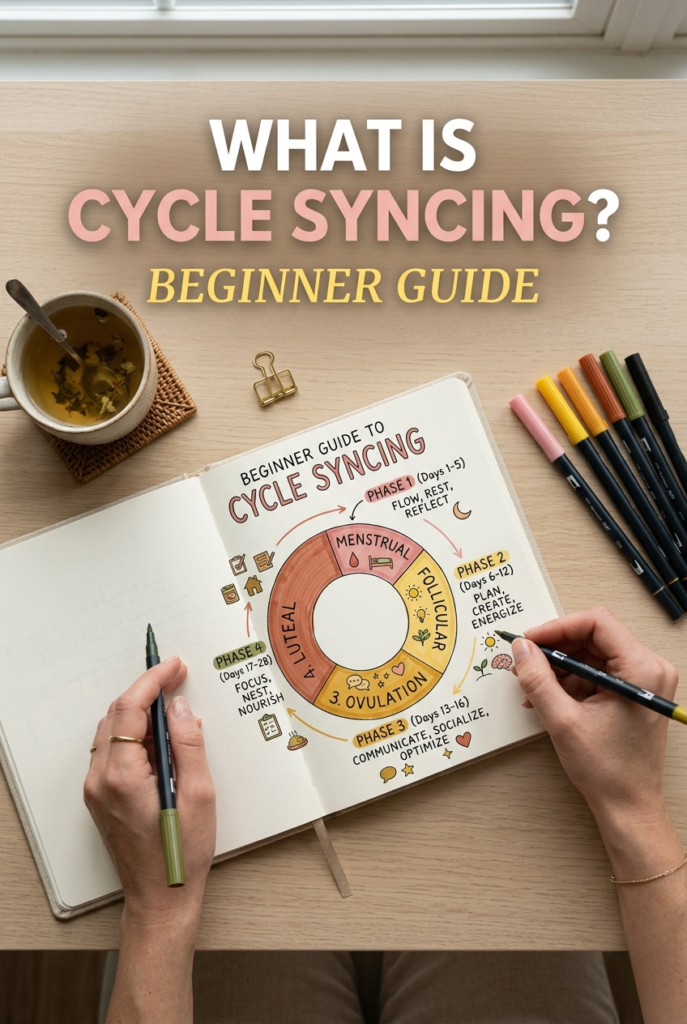
Cycle syncing is a term that has become increasingly popular in women’s wellness — but many women who encounter it are unsure what it actually means, whether it is backed by science, and most importantly, how to actually do it in a practical way. This guide answers all of those questions clearly and simply, without jargon or complexity, for complete beginners who want to understand and work with their cycle rather than fighting against it every month.
| Did You Know? The concept of cycle syncing was popularised by functional nutritionist Alisa Vitti in her book WomanCode. The underlying science — that hormone levels change predictably throughout the menstrual cycle and that these changes affect energy, metabolism, strength, mood, and cognitive function — is well-established in reproductive endocrinology research and has been studied for decades. |
What Is Cycle Syncing?
Cycle syncing is the practice of adjusting your diet, exercise, work habits, social schedule, and self-care to match the four phases of your menstrual cycle. The idea is based on a simple biological reality: your hormone levels change significantly across approximately 28 days, and with those hormone changes come predictable changes in your physical energy, mental clarity, emotional state, metabolism, and even social preferences. Rather than expecting your body to perform the same way every day — which is a fundamentally male-oriented approach to health and productivity — cycle syncing acknowledges that women have a monthly rhythm and works with it.
Why Cycle Syncing Works
When you eat, exercise, and rest in ways that match your current hormonal environment, several things improve simultaneously. Exercise performance improves because you are training when your body is hormonally primed for strength or endurance rather than pushing hard when it needs rest. Nutrition becomes more targeted because you are eating foods that support the hormones dominant in each phase. PMS symptoms reduce because the late cycle phase receives the specific nutritional and lifestyle support it needs rather than the same approach used all month. Energy feels more natural and less forced because you are flowing with your biology rather than against it.
The Four Phases — Simply Explained
Phase 1: Menstrual Phase — Days 1 to 5
This is day one of your period through to the end of bleeding. Oestrogen and progesterone are at their lowest. Energy is naturally lower and the body is focused on renewal. This is your rest phase — the time to slow down, eat warming nourishing foods like soups and iron-rich meals, do gentle exercise like walking and yoga, and reduce unnecessary commitments. Honouring this phase properly determines how well the rest of the cycle flows.
Phase 2: Follicular Phase — Days 6 to 13
The phase after your period ends and leading up to ovulation. Oestrogen rises steadily as follicles develop. Energy increases, mood lifts, creativity peaks, and motivation returns naturally. This is your planning and starting phase — the ideal time for new projects, challenging workouts, social plans, and trying new things. Your body is physically and mentally at one of its strongest points. Eat fresh, lighter foods and take advantage of the energy surge.
Phase 3: Ovulatory Phase — Days 14 to 16
The brief ovulation window when oestrogen peaks and LH triggers the release of an egg. This is your peak performance phase — maximum energy, highest pain tolerance, strongest communicative confidence, and greatest physical strength. Push your hardest workouts here. Schedule important meetings, presentations, or difficult conversations. Eat anti-inflammatory foods to support the brief post-ovulation inflammatory response. This phase lasts only two to three days for most women.
Phase 4: Luteal Phase — Days 17 to 28
The longest phase — from after ovulation to the start of the next period. Progesterone rises then falls. This is the PMS phase for many women. Energy decreases gradually, the need for comfort and routine increases, and the body requires more calories and more rest. Eat magnesium-rich foods, reduce caffeine and alcohol, choose moderate exercise over high intensity, and reduce social and professional overcommitment particularly in the final week. Managing this phase well is where cycle syncing produces the most dramatic improvement in quality of life.
How to Start Cycle Syncing as a Beginner
- Download a free cycle tracking app — Clue or Flo are both free and beginner-friendly. Log your period start date as Day 1 and note daily symptoms, energy, and mood.
- Track for one full cycle before making any changes — just observe and notice patterns. Most women are surprised by how predictable their energy and mood shifts already are.
- Start with exercise syncing only — it is the most immediately noticeable change. Rest in the menstrual phase, build intensity in the follicular phase, push hard in the ovulatory phase, reduce in the late luteal phase.
- After two cycles of exercise syncing, add nutrition syncing — focusing on iron-rich foods in the menstrual phase, seeds and fresh foods in the follicular phase, anti-inflammatory foods around ovulation, and magnesium-rich foods in the luteal phase.
- After three cycles, add lifestyle syncing — scheduling demanding work and social commitments in the follicular and ovulatory phases, protecting rest time in the late luteal and menstrual phases.
| Pro Tip: You do not need a perfect cycle to start cycle syncing — cycles that are irregular, longer, or shorter than 28 days all have the same four phases, just with different timing. Track your own cycle rather than using a standard 28-day template. Apps like Natural Cycles adjust predictions based on your actual data over time. |
Cycle syncing is not a restrictive protocol or a complicated system. It is simply learning to listen to what your body has been telling you every month and giving it what it needs at each phase rather than the same thing all the time. Most women who try it describe it as one of the most empowering health practices they have ever adopted. Start tracking today — and let one full cycle teach you more about your own body than years of ignoring it did.
Disclaimer: This article is for informational purposes only. Cycle syncing is a wellness practice, not a medical treatment. Consult a gynaecologist or healthcare professional for menstrual health conditions or irregularities.